



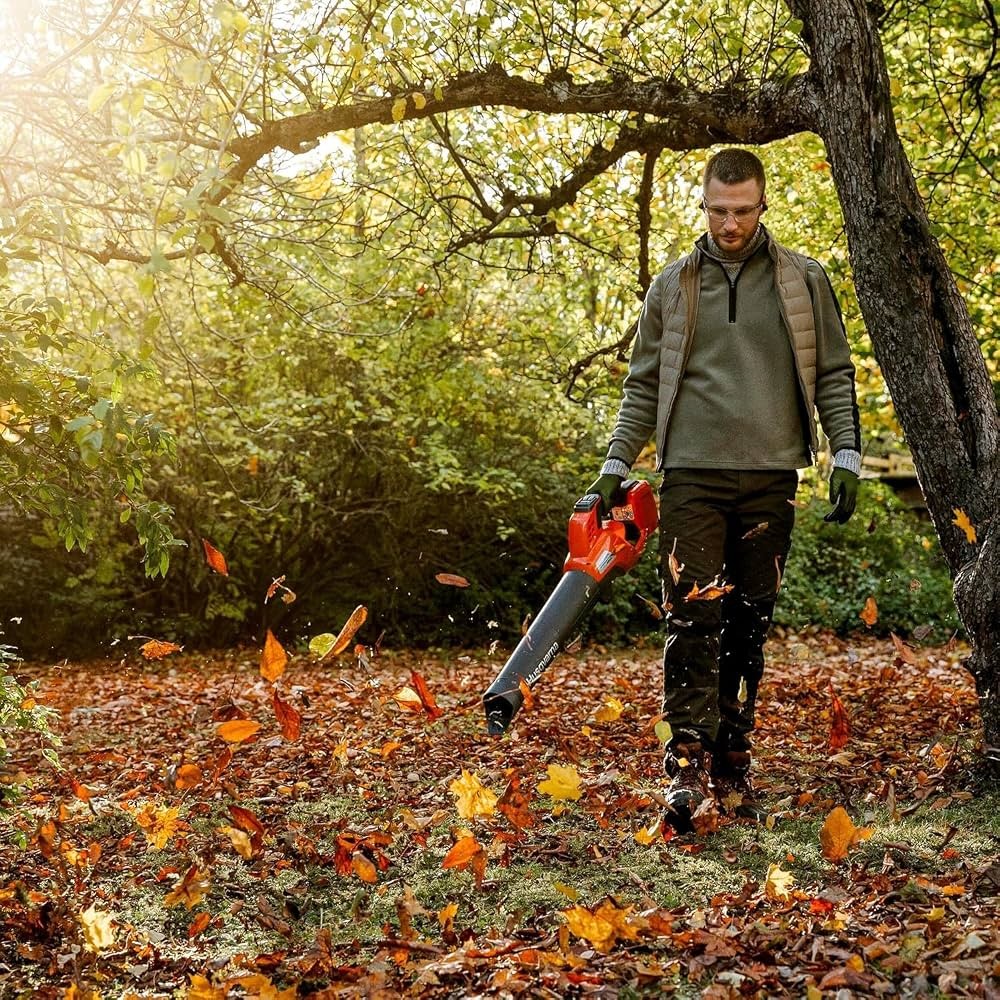
Keeping your garden clean and tidy throughout the year can be a demanding task, especially in autumn, when leaves and small debris accumulate on lawns, pathways and patios. Fortunately, thanks to modern technology, there are tools that make these tasks much easier and faster.
A leaf blower is one of the most useful tools for maintaining outdoor spaces, whether you have a small private garden or work professionally in garden maintenance.
But how do you choose the best leaf blower? What features should you consider before buying one? Let's explore the main differences between the available models and find out how to identify the one that best suits your needs.
Battery-Powered, Electric or Petrol Leaf Blower: Which One Should You Choose?
The first feature to consider is the type of power supply. Each technology offers specific advantages in terms of performance, convenience and operating time.
Battery-Powered Leaf Blowers: Convenience and Innovation
Battery-powered leaf blowers are among the most interesting solutions for those looking for convenience, advanced technology and ease of use.
Thanks to the evolution of lithium-ion batteries and the latest generation of electric motors, these tools offer increasingly high performance while maintaining compact dimensions and relatively low weight.
The main advantages include:
Freedom of movement: no power cables and no need for fuel.
Reduced noise: generally quieter than petrol-powered models.
Minimal maintenance: no maintenance requirements typical of combustion engines.
Instant start: ready to use with a simple command.
Smart technology: some models feature electronic power adjustment and highly efficient brushless motors.
They are particularly suitable for private gardens, terraces, pathways and residential areas. Professional battery-powered models can also deliver excellent performance for more demanding tasks.
Petrol Leaf Blowers: Power and Extended Operating Time
When dealing with very large areas, significant amounts of leaves or intensive maintenance work, a petrol leaf blower remains a particularly popular choice.
These models use combustion engines and allow extended working sessions, with the possibility of quickly refuelling whenever necessary.
Petrol leaf blowers are particularly suitable for professional gardeners, landscape maintenance specialists and operators who work daily on large outdoor areas.
Backpack versions are also available, designed to distribute the machine's weight more evenly and provide greater comfort during prolonged working sessions.
Electric Leaf Blowers: Simplicity and Affordability
Corded electric leaf blowers are a practical and economical solution for those who need to carry out small cleaning tasks near a power outlet.
They are generally lightweight, easy to operate and require very little maintenance.
Their main limitation is the power cable, which restricts freedom of movement and makes these tools less suitable for very large areas.
What Features Should You Consider Before Buying a Leaf Blower?
In addition to the power supply, several key technical characteristics can make a significant difference between models.
1. Air Speed
Air speed, generally measured in km/h or m/s, indicates how quickly air is expelled from the blower.
Higher air speeds help move wet leaves, small twigs and debris that is more difficult to remove.
However, air speed is not the only factor that determines a leaf blower's effectiveness.
2. Air Volume
Air volume indicates the amount of air moved by the machine and is generally expressed in cubic metres per hour (m³/h) or per minute (m³/min).
A high airflow volume allows larger quantities of leaves to be moved simultaneously, making cleaning operations faster across extensive areas.
When choosing a good leaf blower, it is therefore important to evaluate the balance between air speed and airflow volume.
3. Blowing Force
Another particularly useful parameter is blowing force, measured in Newtons (N).
This value represents the overall pushing force generated by the airflow.
When available and measured using comparable standards, it is one of the most useful indicators for comparing the performance of different machines.
4. Weight and Ergonomics
A powerful leaf blower should also be comfortable to use.
Before purchasing, it is important to consider the overall weight, handle design, balance and the presence of anti-vibration systems.
For extended working sessions, backpack models can be particularly advantageous, as they distribute the load across the shoulders and back rather than concentrating it on one arm.
5. Battery Life and Fuel Consumption
For battery-powered leaf blowers, checking the actual operating time is essential, considering that battery life can vary significantly depending on the selected power level.
It is also useful to check whether the battery and charger are included in the package and whether the batteries are compatible with other garden tools from the same brand.
For petrol-powered models, the fuel tank capacity and engine consumption should also be taken into account.
Handheld or Backpack Leaf Blower?
Another important consideration is the machine's design.
Handheld leaf blowers are compact, easy to handle and ideal for quick cleaning tasks. They are particularly convenient for domestic gardens, courtyards and pathways.
Backpack leaf blowers, on the other hand, are mainly designed for demanding and continuous work. Thanks to their ergonomic harnesses, they allow operators to use heavier machines while distributing the load more comfortably.
These models are especially popular among professional gardeners and landscape maintenance specialists who require high performance and comfort during long working hours.
Leaf Blower or Leaf Vacuum?
Before purchasing, it is also important to consider the functions you need.
A leaf blower allows leaves and debris to be moved quickly, gathering them into specific areas for easier collection.
A leaf vacuum, on the other hand, collects the material directly into a dedicated bag. Some models also feature a shredding function that reduces the volume of collected leaves.
There are also multifunction machines that combine blowing, vacuuming and shredding, offering greater versatility.
The best choice mainly depends on the size of the area to be cleaned and the type of material to be collected.
What Is the Best Leaf Blower for Your Needs?
There is no single best leaf blower for everyone: the ideal choice depends primarily on how you intend to use it.
For small gardens and domestic spaces, a lightweight and compact battery-powered leaf blower is generally the most practical solution. It offers freedom of movement, ease of use and reduced maintenance.
For medium-sized gardens, choosing a battery-powered model with good airflow volume and sufficient operating time is recommended. Adjustable power settings can be particularly useful for adapting the airflow to different surfaces.
For large gardens, parks and extensive areas, a petrol-powered blower or a professional battery-powered model may be preferable, as these machines can handle large quantities of leaves and debris.
For professional gardeners, high-performance backpack models are often the most suitable option, thanks to their combination of power, ergonomics and ability to handle continuous work.
How to Use a Leaf Blower Correctly
To achieve the best results, it is important to operate the machine properly.
Start from the outer areas of the garden, gradually directing leaves towards a designated collection point.
The airflow power should be adjusted according to the material being moved: moderate airflow may be sufficient for dry leaves and grass clippings, while heavier debris requires greater force.
It is also important to pay attention to wind direction, avoid unnecessarily blowing dust and debris towards people or animals, and use appropriate eye and hearing protection according to the manufacturer's instructions.
Finally, regular maintenance helps preserve the machine's performance and extend its service life.
Conclusion: Choosing the Right Leaf Blower Means Working More Efficiently
Choosing the best leaf blower should not be based exclusively on power, but on a combination of characteristics including performance, operating time, ergonomics, technology and reliability.
Modern battery-powered leaf blowers are becoming increasingly advanced and versatile, while petrol-powered models remain particularly popular for intensive work.
Investing in a high-quality leaf blower means reducing cleaning time, improving comfort during use and keeping outdoor spaces consistently tidy.